Don’t Follow the Herd. Build Stability in a Volatile Market.
1. Introduction: The Gap Between Data and Reality
If you look solely at the headlines this week, you might think Japan’s inbound tourism is cooling down. Recent government data shows a sharp deceleration in the growth rate of Chinese visitors to Japan—dropping to a mere 3.0% increase in November. Hotels are reporting cancellations, and department stores are seeing a dip in tax-free sales.
Economists are already warning about the economic risks of “single-market dependency.”
However, data often fails to capture the texture of reality. Last week, I visited Kyoto for a business site inspection. What I witnessed there was not a “slowdown,” but a state of absolute saturation. This disconnect between the statistical dip and the on-the-ground chaos offers a profound lesson—not just for the tourism industry, but for those of us in real estate investment.
2. A Site Visit to Kyoto: The Loss of Serenity
My destination was the Higashiyama district, home to the iconic Kiyomizu-dera Temple. Or at least, that was the plan.
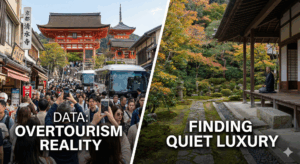
The reality was a classic case of overtourism. The narrow streets leading to the temple were so packed with foreign tourists that it was physically impossible to walk at a normal pace. The noise, the congestion, and the sheer volume of people were overwhelming. In the end, I gave up on visiting the temple entirely.
As a Japanese person who truly loves the history, culture, and unique atmosphere of Kyoto, I felt a deep sense of regret. The “Kyoto-ness”—that serene, authentic, spiritual atmosphere—has completely vanished from these major hubs.
However, there was a silver lining. I decided to pivot and visit some smaller, lesser-known temples nearby. The contrast was stark. These minor spots were quiet, dignified, and breathtakingly beautiful. The intrinsic value of Kyoto was still there; it was just hidden away from the herd.
3. The Risk of “Single-Country Dependence” and “Hyper-Concentration”
The current situation in the tourism sector highlights a fundamental business risk: Vulnerability through lack of diversification.
For years, the Japanese tourism industry relied heavily on the massive volume of visitors from a single neighbor: China. Now that geopolitical and economic winds are shifting, businesses that optimized solely for that market are scrambling.
As a CCIM (Certified Commercial Investment Member) and a real estate investor, I see a direct parallel in property investment.
-
Tenant Risk: Relying on a single demographic or industry for your rental yield exposes you to volatility.
-
Location Risk: obsessing over “Brand Name” districts (like the crowded Kiyomizu-dera) often means buying at the peak of the market, where yields are compressed and the living environment is actually deteriorating due to congestion.
Sustainable growth—whether in tourism or real estate portfolios—requires resilience against these shifts.
4. Where is the True Value? (Finding the “Hidden Gems”)
The lesson from my Kyoto trip is clear: Avoid Herd Mentality.
Just because a location is “famous” does not mean it holds the best value. In fact, in the current Tokyo market, the most well-known districts are often overheated.
Real value—what I like to call “Quiet Luxury”—is found by looking where the crowd is not looking. Just as I found peace in the minor temples of Kyoto, smart investors and expats can find superior quality of life and better asset appreciation in the “hidden gem” neighborhoods of Tokyo. These are areas that offer:
-
Livability: Quiet, green, and safe environments suitable for families and professionals.
-
Authenticity: A connection to the real local culture, rather than a tourist trap.
-
Stability: Value derived from intrinsic quality, not temporary booms.
At my firm, I don’t just help clients “buy a house.” I use my background in global business and investment analysis to help you identify these pockets of long-term value.
5. Conclusion: Building Stability in a Global Era
The “China Boom” in tourism may be settling, and the market is shifting toward a more diverse mix of visitors from Europe, the US, and Southeast Asia. Real estate is no different. Trends change, but the principles of sound investment remain constant.
Having lived and worked in the UK and Australia, and having navigated the corporate world at Sony and trading houses, I understand the importance of a global perspective. I established this firm to provide a bridge for international clients—offering data-backed advice (MBA/CCIM) combined with the local insight of a Tokyo native.
If you are looking to enter the Japanese market, do not just follow the crowd. Let’s find the real value together.
Let’s Connect
Are you an expat looking for a high-end residence, or an investor seeking a stable asset in Tokyo?
Contact Toshihiko Yamamoto today.
I offer personalized, English-speaking real estate services tailored to the needs of the international community. Let’s discuss how we can secure your foothold in this dynamic city.
Source(Japanese) :Yomiuri shimbun
Connect with Us for Exclusive Listings & Investment Insights
- LINE – Direct inquiries in Japan
- WhatsApp – For global investors & clients abroad
- Instagram – Market snapshots, listings & updates
- YouTube – In-depth property videos & expert analysis
📱 Scan below to connect instantly.



About the book
Amazon.com Link

#JapanRealEstate #InvestmentStrategy #Kyoto #Overtourism #QuietLuxury #ExpatsInJapan #CCIM